The tradition of the
Boston Marathon will forever trump a simple act of terror
Growing up just North of Boston there were few days I
cherished more than Patriot's Day, or as New England runners know it,
"Marathon Monday". Patriot's Day is a uniquely New England experience
and as a young Massachusetts runner it was a day I always looked forward to - both
to watch the marathon I one day hoped to compete in but also to take in the traditional
11am Patriot’s Day ballgame.
My love affair with running began at an early age and was
largely driven by my obsession with the Boston Marathon and its history. A family
friend who was a longtime runner took me under his wing and motivated me to
take up the sport myself. I started running road races when I was ten years old
and continue to this day, largely because of my respect for the marathon, a respect
that was cultivated throughout my childhood and as a byproduct of the culture
of running that existed around the marathon in New England.
I remember attending the marathon expo as a young
budding runner and collecting autographed action shots of Bill Rodgers, Frank
Shorter, Joan Benoit-Samuelson, Uta Pippig, and, of course, the great Johnny
Kelley. I remember competing in the Heartbreak Hill youth one-miler and
imagining the history of the race as I did my best to attack the historic
stretch of the marathon. But most of all I remember how much the race meant to
me then and still does to this day. It is quintessential Boston, quintessential
New England, and we love it for that and so much more.
The people of Boston and Massachusetts are an
extraordinarily proud people. We are extremely loyal to our state and our
favorite city, to such an extent that at times the rest of you hate us for it
(don’t lie, you know it’s true). We take great pride in our home and all that it
has to offer – its rich history of revolution, the traditions of the sports
teams we cheer for as if they are family, and the oldest and most prestigious marathon
in the world that is a rite of spring for New England.
That is why we were so saddened to see Monday’s tragedy
unfold. Like so many other cities and communities that have and do endure
hardship, we are shaken not just to see our city come under attack but also to
see it happen during our most prized tradition. No matter what emerges over the
coming days I can assure you this much is true: regardless of what those who
perpetrated this attack aimed to accomplish, The Boston Marathon is not and
never will be a story of terror. Its history is too rich and its tradition too
strong. The Boston Marathon is a story of perseverance and nothing will ever
change that.
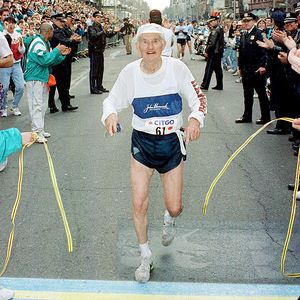
It’s the story of Johnny Kelley, who won the marathon in
both 1935 and 1945, but is best known for running the jaunt from Hopkinton to
Boston a record 61 times. For decades there was no more iconic image of the
race than Johnny Kelley crossing the finish line after having smiled through another
26.2 miles. "I'm afraid to stop running”, Kelley said at the spry age of
70, “I feel too good. I want to stay alive”. Kelley ran Boston for the last
time in 1992 and passed away in 2004. There were few people who inspired me
more to become a runner than him. I still draw inspiration from his story and his
life and I imagine many other runners do as well.
It’s also the story of Dick and Rick Hoyt, an inspiring
father-son team that to Bostonians are synonymous with the marathon. Dick Hoyt,
a retired Lieutenant Colonel of the Air National Guard, has competed in more
than a thousand endurance events over the past few decades. What makes Dick
particularly special, though, is that he has completed every one of those
events with his quadriplegic son, Rick, who suffers from cerebral
palsy. The image of Dick Hoyt pushing his son Rick in his wheelchair year after
year is another of those inspiring iconic images of the marathon that so many
throughout New England draw energy from. Tragically, the Hoyts were stopped
about a mile short of the finish line on Monday, but you can rest assured they
will be back next year.
A statue of the Hoyts stands in Hopkinton near the marathon’s
starting line and one of Kelley near near city hall in Newton. They are icons and
symbols that the people of Boston and Massachusetts draw inspiration from. The
Boston Marathon is their story and the story of so many others who inspire us
as they overcome their respective challenges to compete in the world’s oldest
and most prestigious marathon. Just as much as Boston is the prize the world’s elite
distance runners covet, it is a story of the perseverance of ordinary people. It’s not who will don the wreath at the end of
the race that we follow most closely each year, but the inspirational stories
of so many amazing people who compete year in and year out.
It is because of this rich tradition that the Boston
Marathon will never be a story of terror. It will always be a story of
perseverance. We are too stubborn to have it any other way. It will take much more
to shake the resolve of this city and these people than a simple act of terror.
It will take much more to tarnish the history and tradition of the marathon that
we hold so dear. Next year, we will run and we will cheer. We will raise money
for myriad causes and we will shed tears of joy as we accomplish our feats and
as we watch those we love accomplish theirs. You will never
take our tradition away from us. You will never take our race away from us. And
you will certainly never take our pride. You have only strengthened our resolve. We are the Boston Marathon and we will
persevere.
